http://www.indiavideo.org/literature/srilal-shukla-satirist-hindi-literature-3775.php#Desc
Friday, October 28, 2011
Handwritten Letter & Message from Jnanpith Award Recipient ‘Shrilal Shukla’ (श्रीलाल शुक्ल)
http://www.indiavideo.org/literature/srilal-shukla-satirist-hindi-literature-3775.php#Desc
Monday, August 1, 2011
Sunday, July 10, 2011
HANDWRITTEN LETTER OF BABA AMTE & SADHANA AMTE
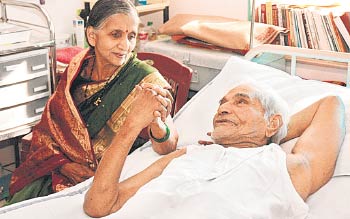
Baba Amte & Sadhana Amte made a great impact on my mind & inspires me a lot from my schooldays. I start following Baba Amte after reading a chapter on him in lower class Marathi textbook. I remember, when I was in 10th standard, I successfully translated Baba Amte’s Marathi poem ‘Manush majhe naav’ in Hindi as ‘Manushya Mera Naam’.
I got a rare opportunity to communicate with both Baba & Sadhana Tai during 1992-93 Mumbai Hindu- Muslim riots.[ http://en.wikipedia.org/wiki/Bombay_Riots ].
Both were stay at Mahim, Mumbai & tried to stop violence through Gandhian way but faced many obstructions by anti social elements. At the peak of riots, I post a letter to Baba with my feelings about burning Mumbai & breaking relations. I was not expecting any reply from him. I was surprised when I got a handwritten postcard from both couple dated as 8th Feb. 1993. I was thrilled when I read this letter. Even today when I read this letter I become emotional.
Sadhana tai wrote her part in Marathi with starting in Hindi as ‘Baba likh nahi sakte’[Baba unable to write]. Other side of card Baba wrote that he is not ‘jyotishy’(astrologer) but he is predicting that one day I will definitely become a good writer. After reading these words, tears were flow from my eyes. Baba’s those words inspires me in every up down of life. From school days, I start writing short stories for children. Many of them were published in ‘Bal Bharti’ (Publication Division, I & ministry) & other magzines..Today because of Baba’s blessings in my school day time, I created a number of World records in creative writing.
Baba Amte & SadhanaTai were true Gandhian & devoted whole life in the service of poor & needy people. Except Nobel Prize, Baba Amte was awarded by world’s all prestigious awards & honours.
Baba Amte with Dalai Lama
http://mss.niya.org/people/baba_amte.php
http://www.anandwan.in/
Thursday, October 7, 2010
Narayan Surve – Life, Work, Handwritten Letter & Autograph
- Majhe Vidyapeeth (1966)
- Jahirnama (1978)
- Aisa Ga Mi Brahma
- Sanad
- Manush Kalawant
- Ani Samaj
- Sarva Surve (Editor: Vasant Shirwadkar)
- Mastaranchi savli
तुम्ही खुशाल समदी हावा , असं पत्रात लिवा।।
संशय माझा आला तर , नाही जाणार मी बाहेर
पाणी आणाया जाउ का नको, काय ते पत्रात लिवा।।
शंभर रूपायचा हिषोब मागता , मी काय एकटीनं खाल्ले
लाईटचे वीस दिले, पाण्याचे तीस दिले, पंचवीसचे राशन आणले
दूधवाल्याचे पन्नास देउ का नको , काय ते पत्रात लिवा।।
बाळाला आला ताप अन् खोकला, प्रायवेटला घेउन गेले,
त्याला जे. जे. ला नेउ का नको, काय ते पत्रात लिवा।।
बेबीला आताशा शाळेत घातलय, अभ्यास चांगला करते
आयाबायांनी शिकायला पायजे, वस्तीच अख्खी बोलते
मी बी शिकायला जाउ का नको, काय ते पत्रात लिवा।।
जवापासून तुमी गेला परदेषी, माजलेत इथे लफंगे
घडून मिळून राह्याच सोडून, धर्माच्या नावावर दंगे
समद्या वस्तीला समजावू का नको, काय ते पत्रात लिवा।।
नारी मुक्तीच्या मरतात सभा, मीटींगला आम्ही जातो
बहिणीला तुमच्या मारतो नवरा, सगळयाजणी धमकावतो,
तिला सोडवाया जाउ का नको, काय ते पत्रात लिवा।।
कोण्या मेल्यानं तुम्हा कळीवलं मी ठुमकते रस्त्यावर,
मीटींगला जाते, मोच्र्याला जाते, त्याविना कसं जमणार,
Sunday, October 3, 2010
Bhisham Sahni : Life, Works & Handwritten Letter
Bhisham Sahni was a distinguished Hindi fiction writer, playwright, translator, teacher and actor.
Bhisham Sahni is most famous for his epic work Tamas (Darkness, 1974) which is a novel based on the riots of the 1947-48 Partition of India which he witnessed at Rawalpindi. Tamas portrays the terror-stricken Hindu exodus from Muslim majority areas, though the overall theme remained the human-story behind the entire carnage. . He made the point that the real victims of all sectarian violence are the hapless common folk, irrespective of religious or denominational differences. It has been translated to English, and several Indian languages including Gujarati,Malayalam, Kashmiri, and Manipuri. Tamas won the 1975 Sahitya Akademi Award for literature, and was later made into a television film in 1987 by Govind Nihalani.
Bhisham Sahni was born on 8 August 1915 in Rawalpindi. He earned a master's degree in English at Government College in Lahore, and also attended Khalsa College, Amritsar.
Bhism Sahni was a part of freedom struggle. He joined the Indian National Congress & jailed for his participation in the Quit India Movement of 1942. Upon Partition, he and his Punjabi Hindu family were forced to move to Amritsar. When communal riots broke out in Rawalpindi in March 1947, he worked with the Relief Committee.
He was the younger brother of the one of the greatest Hindi film actor, Balraj Sahni. Under the guidance of Balraj Sahni, later he joined the Indian People's Theatre Association (IPTA) in Mumbai and worked as a performing artist. He directed the famous drama Bhoot Gari adapted for the stage by Khwaja Ahmed Abbas.
In 1950, he joined Delhi College as a lecturer in English. He lived in Moscow from 1957 to 1963 and worked as a translator from Russian to Hindi with the Foreign Language Publishing House, Moscow. In addition to Hindi, Sahni is also proficient in English, Urdu, Sanskrit, Russian, and Punjabi. He has translated twenty-five books from Russian into Hindi, including Tolstoy's Resurrection.
He was general secretary of the Progressive Writers Association, and was the founder and chairman of 'SAHMAT', an organization promoting cross-cultural understanding, founded in memory of the murdered theatre artist and activist Safdar Hashmi.
He has written more than a hundred short stories, compiled in several volumes, most notably Bhagya rekha (1953), Pahla patha (1956), Bhatakti rakha (1966), and Nishachar (1983). His short stories reveal a fine sense of craft. Those considered among the masterpieces of Hindi literature include Chief ki davat and Amritsar a gaya hai. He has written stories for children that are collected in the volume Gulal ka khel. Sahni has also written three plays Hanusa (1977), Kabira khara bazar mein (1981), and Madhuri (1982).
Bhisham Sahni wrote his autobiography "Aaj ke Ateet" (Pasts of the Present), and also wrote biography of Balraj Sahni in English under the title Balraj my brother (1981).
His works reflect his unflinching commitment to India's pluralist ethos and secular foundations. . His command over local dilects and to the common languages such as urdu and punjabi has enabled him to attach his writing to the hearts and minds of common people. Most of his short stories, are the stories about the common people who are toiling under the brutal cog-wheel of the Socio-Political-Economic bitterness. A reader can feel the emotional bond with the characters of his stories, and that makes him able to caricate the bitter hardship of his time. All his works are characterized by a sense of compassion, values of universal humanism and lucid narrative
As a actor he appeared in several films, including Saeed Mirza's Mohan Joshi Hazir Ho! (1984), Tamas (1986), Kumar Shahani's Kasba (1991), Bernardo Bertolucci's Little Buddha (1993) and Aparna Sen's Mr. and Mrs. Iyer (2002).
Bhisham Sahni has received a number of awards, such as the Shiromani Writers Award(1979), the Sahitya Akademi Award for Tamas (1975) and the Uttar Pradesh Government Award for Tamas (1975), Madhya Pradesh Kala Sahitya Parishad Award, for his play Hanush (1975),the Lotus Award from the Afro-Asian Writers' Association(1981), Colour of Nation Award at International Theatre Festival,Russia for Play Madhavi by Rashi Bunny (1981), and the Soviet Land Nehru Award (1983), the Padma Bhushan for literature(1998) and India's highest literary award the Sahitya Akademi Fellowship (2002) .
On July 11, 2003 at the age of 87, he died at Delhi.
I got a rare opportunity to communicate with Bhishmji. In the first week of Jan 1999, he replied to my lengthy letter. In his handwritten postcard, he gave me blessings & also New Year greetings.
See Bhisham Sahni introducing Govind Nihalani's television film Tamas (1987) at http://www.youtube.com/watch?v=nlo2gXsFOt0
Monday, September 6, 2010
Sunday, September 5, 2010
Tuesday, August 17, 2010
Gopal Godse, the most infamous conspirator in the assassination of Mahatma Gandhi & his handwritten letter
From High school days I am writting letters to eminent personalities from various fields like art, literature, politics & others of our country. In the same process when I was doing my M.Sc. in Physical Chemistry from Ismail Yusuf College (Mumbai)
on 7th July, 1999, I wrote a long letter to one of the most infamous personality of our country Gopal Godse. I got his address from a Marathi book from Keshav Gore Trust Library. In that letter I asked a number of questions related to the Nathuram Godse, Mahatma Gandhi, actual reasons for the assassination of Gandhiji & life after prison. I was not sure about any reply from him but I was totally surprised to see his reply which I got on 25th July, 1999. His reply is in the form of handwritten letter.
In his letter Gopalji gave me blessings for long life by writing 'Chiranjeev'. He suggest me to study his written books for the answers of questions which are asked by me in my letter. He informed me that cataract operation for his both eyes were necessary so after 2/4 days he will undergo an operation for one eye & after 2 month he will undergo for second eye. In last paragraph he informed me that he had a problem of Physics. That time he was using ancient Vedic Hindu sage Agatsya's mantras, wanted to make dry cells. From my letter he knew that I was Physical Chemistry student so he wanted my help in that invention. I was totally trilled with this kind of reply.
When I share this letter experienced with college friends & teaching staff they advised as well as warned me to not to make any kind of relation with Gopalji otherwise I have to face many unwanted problems. That time he was still under the observance of Intelligence & state CID. That time I was very serious about career.I was working hard for civil service examination & wanted to become IAS at any cost. I was the only hope of family & every one's expectation was very big from me.So I took elders advice.

Now I can feel that how lonely & isolated life lived by Gopalji. On 27th November, 2005 he died in Pune (Maharashtra).
I believe that my & also my previous generation can not evaluate that 1947-48 situation. We are ordinary common man. God only knows who was right & who was wrong.

Let us all we have to know little bit about Gopal Vinayak Godse.
Who was Gopal Gadse?
Gopal Godse was a Chitpavin brahmin born in 1919 in Khed (now Rajguru Nagar) in Pune,Maharashtra. He worked as a volunteer for Rashtriya Swayamsevak Sangh (R.S.S.) & Hindu Mahasabha without enrolling as a member. When world war II broke out, in 1940 he joined defense services as a storekeeper in the Indian Army Ordinance Corps. He opted for service on the front & served in Iran & Iraq till April 1944.
Gopal Godse & his elder brother Nathuram Godse believed that Mahatma Gandhi had turned his back on Indian independence movement at that his actions led to the partition of India which in turn led to inflammation of sectarian strife between Pakistan's Muslim's & India's Hindu's. According to Gopalji what triggered the assassination was a bomb explosion 20th January,1948 at Gandhiji's prayer meeting in Delhi, just 50 meters away from Gandhiji. The failed explosion for which Madan Lal Pahwa was caught heighten the urgency- Godse brothers wanted to finish it before Indian police caught them. Finally on 30th Jan, 1948 Mahatma Gandhi was shot dead by Nathuram Godse. Nathuram along with co-conspirator Narayan Apte was executed by hanging on 15th November,1949. Gopal Godse & two other were sentenced to life imprisoned for their major part in conspiracy. Gopalji remained in jail for 18 years. In Oct,1964 he was released from prison but after a month he was re-arrested under the Defence of India Act & kept in prison for over a year. He was finally released at the end of 1965. After released from prison, he lived with his wife Sindhu in a small apartment in Pune.
Gopal Godse lived largely on the royalties obtain from books he wrote on Mahatma Gandhi & the assassination. He wrote 9 books in Marathi & English language.
- Has a life convict to die in prison under Indian law? - 1961
- Jaya Mrityunjaya - 1969
- Krantikarakancha Adhyatmavad Aani Itara Lekha -1971
- Panchavanna Kotinche Bali (The sacrafice of 55 crores) - 1971
- Saine Ka Lihila Jai Rashtracha Itihaas? - 1975
- Lal Kilyatila Athavani - 1981
- Gandhi Hatya Aani Me (Gandhi's assassination & me) - 1989
- Qutub Minar Is Vishnu Dhwaja - 1997
- Phansi Aani Nathuram - 1999
In another interview to an international media, when following question asked to him, he replied as,
Q :- Do you ever regret Mahatma Gandhi's killing?
A :- No, never.Gandhi used to claimed the partition would be over his dead body. So after partition he didn't die, we killed him. Usually an assassination of a leader is either for personal benefits or to acquire power. We killed Gandhi because he was harmful to India & it was selfless act. No one paid a single penny for it. Our love for motherland made us to do it. We are not ashamed of it.Gandhi should have been honest to admit that his life was a failure.
Gopal Godse admitted that at one point Gandhiji was his idol. He credited Gandhiji for his mass awekening that he created & that he removed the fear of prison from the mind of Indians.